Tuesday, June 27, 2006

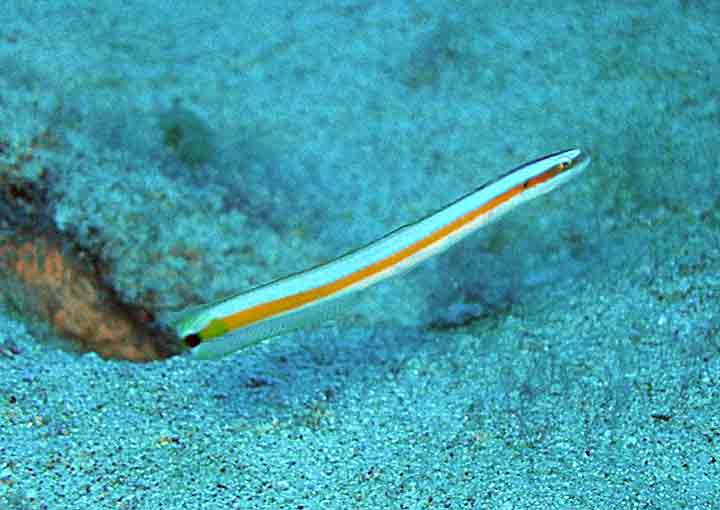
The curious wormfish of Kona Hawaii


This isn't the best picture of one of these little fish, but it's the only one I have. They are interesting fish in that they have an almost eel-like flexibility that you generally do not see in freeswimming fish. Looking at the photo you can see the false eyespot on the tail - the real eye is on the right side in this picture. They do tend to dart into holes when you approach, we don't see them often. I took it today on a quick "captain's dive" (I captained the boat today, but one of my crew is also a captain, so I was able to sneak in the water during the surface interval) between dives one and two on today's charter.

It was a quick dive, but I managed to see an eagle ray, a tiger moray that was burying itself into the coral before I could get there, a school of Heller's barracuda, the Curious Wormfish (Gunnellichthys curiosus), bunches of anthias and about a 40-50 pound Jack and ohter goodies. I was in a hurry and didn't get close enough to anything to get a decent shot, so the wormfish is about it for today.

Later,

Steve

Monday, June 26, 2006

Whoohoo... Oregon State Beavers National Champs!!!

Baseball. Ok, as an ex-OSU student I had to be happy. Sorry, no pic.

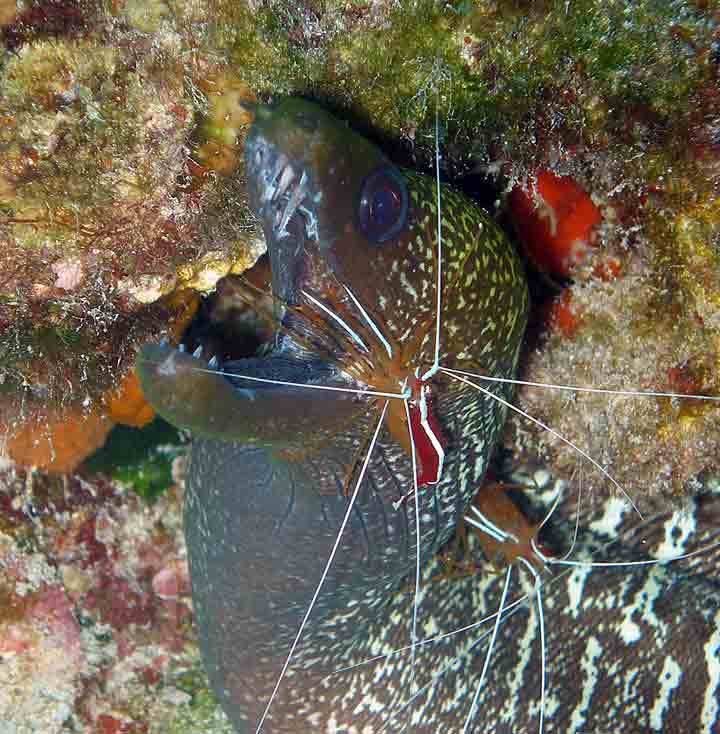
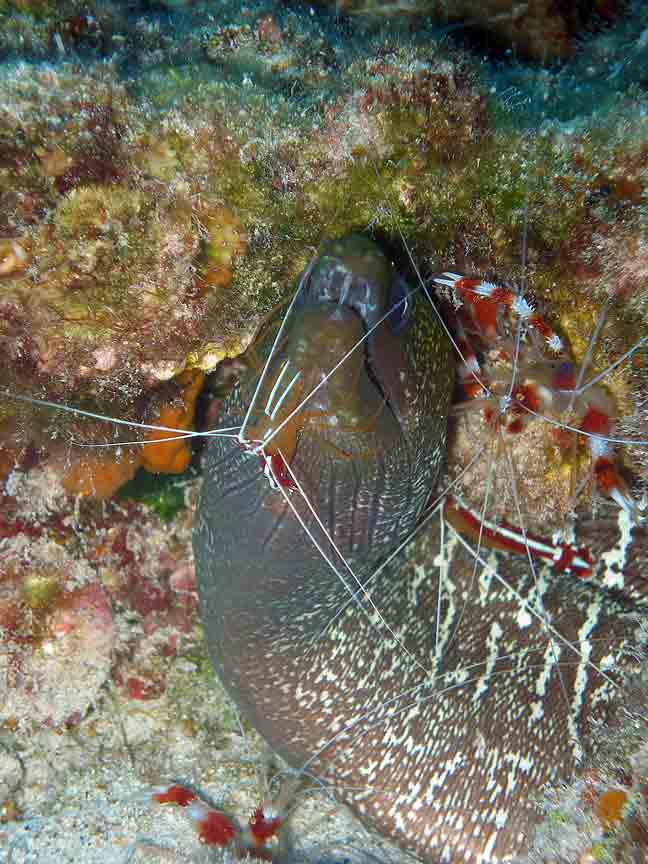
Eel Cleaning Station....Cleaner shrimp clean eels of parasites.


The last post was really long and spammy. Yuck.

Scuba certification. How to become diving certified. Dive classes and instruction.


I'm probably rehashing some older posts here, but I thought I'd talk a little about learning to dive. For those of you who are already certified, this will be of little interest, it may come in handy if you are not.

For obtaining your scuba certification, you will have lots of training options. There are numerous dive training agencies (PADI, YMCA, NAUI, SSI, SDI... etc) you will find that offer training programs in the US, as well numerous more outside the US. Dive shops and instructors will be affiliated with at least one or more training agency. For recreational diving, in general, it's not so much the agency but the instructor you will personally be dealing with that's important. Find someone you are comfortable working with.

The agencies have set up courses, course materials and training methods your Instructor will use to introduce you to this facinating hobby.

There are a few different ways to take your course I'll mention here. I'm going to make some generalizations that may not really hold true in all occasions, but do tend to hold up in many circumstances.

Most of the mainland operators tend to offer the course in several sessions, often over a few weeks, with 4-5 days/evenings of classroom and pool work and then a follow up weekend with 4 or more dives. In tropical resort destinations, you'll often find a 3-4 day course which covers the same material at a faster pace. There are pros and cons in both cases. With the longer course, you will usually spend more time focusing on the front end training.... academics and pool skills, than you are likely to be spending time on while doing a resort based 3 or 4 day class. In many resort locations, all the same material is covered, but often at a quicker pace with a potential for less repetition on the pool skills than in the longer courses. For those who don't catch on skill-wize quickly, or are nervous, apprehensive or less physically conditioned, the short course may not be as good of an option as the longer courses.

With the shorter course, you'll be moving at a faster pace on the front end and then proceed to the open water dive training. Depending on the operator, you could get done quite quickly.

Back when I assisted with classes on the mainland, the general lines often used were "If you get certified here, you'll be able to dive in most any conditions" and "you don't want to waste time on your vacation with training dives". I think the reality was that after freezing their tails off in cold murky water, a third of the newly certified students weren't really all that interested in ever diving again. In many cases it was a matter of going down with the group, having them do the skills and then trying to make it to the required 20 minutes underwater without anyone freezing or running low of air. Now this can all vary by location, as I'm sure there are some mainland training spots which are clearer and warmer than where I did my early training.

If you are planning on picking up scuba, and dive travel is not in the plans, then find yourself an Instructor you personally enjoy and go for the course. If dive travel is in the plans, then read on...

The big payoff with the resort based courses is the water conditions for your open water dives. Now that I'm active teaching here, we get to see a lot of students who actually get some good reef diving in during their course and get hooked on the hobby. I am not meaning to condemn getting certified on the mainland in favor of taking a course in a tropical location though....

My personal feeling is that the best option, for those who are considering dive travel for certification or immediately after certification, is the referral system. Pretty much all the agencies have set up their courses so you don't necessarily have to start and finish your course in the same location or with the same Instructor. This can give you the best of both worlds.... get some good front end instruction at home over several sessions, and then do your Open Water certification dives while on vacation.

In my case, I would love to have referrals who've already done their training on the mainland who would come to me for their Open Water dives. I generally take referral students as they call (but you'll want to call well in advance) and not worry about trying to set up large classes, so my typical class size is just one or two, maybe more if a family is calling. The referral students generally come ready to go and we don't need to do an extended day of pool and academics - we can concentrate on the diving. With the small class sizes I generally have, we get to do more diving than skill work on the dives. The skills themselves usually only take up 5-10 minutes of each dive, and then the rest of the dive is just plain fun diving. I just finised a student 2 days ago who had nearly 4 hours underwater on his Open Water certification dives... he'll be hooked.

There are still other options for those who are not sure if they would like to go through a certification course. Most resort operators offer introductory dives or "discover scuba" dives. This will allow you to see if you are interested in persuing a scuba certification at a later date, or you could complete the course following the intro dive if you have enough time at your destination.

You've got lots of options, and this is a lot of information to take in, but hopefully this helps some. If you are interested in learning to dive, contact your local dive centers and see what they have to offer. It's a blast!!!!

Aloha,

Steve
Sunday, June 25, 2006

A day off from my scuba job.... so I went diving again.


I'm still trying to figure out the camera. I'm having fun with it. I went down to the Place of Refuge again for a shore dive and went back to the rock with the shrimp from the other day. Today there was an Undualte Moray (Gymnothorax undulatus) in being cleaned by both the scarlet lady cleaner shrimp and banded coral shrimp - it got crowded in his little hole. I took a pile of pictures, and that's sort of what it takes to get the one where most everything you want is in focus. This was one of two out of about 12-15 shots that came out fairly OK - everything else was either the eel or the shrimp out of focus, this one was close. Next time I'll try some manual settings, ratehr than the "underwater macro" preset on the Olympus sp-350, to see if that helps.

This is a closeup shot of one of the christmas tree worms on that coral head shot I posted earlier. They are neat. I still need to get a real crisp shot of one. It might take some practice to get what I want.

Aloha,

Steve

Saturday, June 24, 2006

Things to do in Kona Hawaii.....


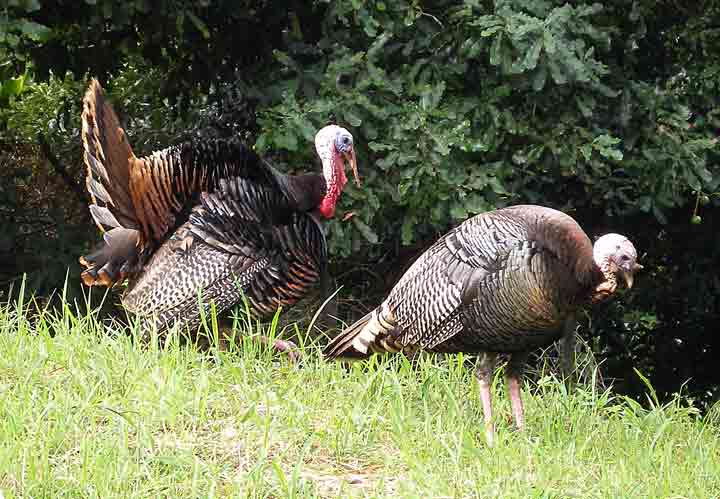
Well, besides watching turkeys - yes turkeys are gettting quite common at elevation here, we've got 2 hens with chicks up our road right now - you've got all sorts of stuff to do here. This particular shot was taken just up the hill from us, those are mac nut trees in the background. We tend to see more pheasants than turkeys in our yard.

The two things that you can do here which I consider to be world class, as in you are unlikely or hard pressed to be able to do this anywhere else in the world, are the manta ray night dive and visiting the lava flow. The lava flow does happen to be on the other side of the island, which is a bit of a trip (2 .5 hours or so by car) but well worth it when the lava is flowing and you can approach it. The lava flow is also worth a blog on it's own, I'll leave that for someone else.

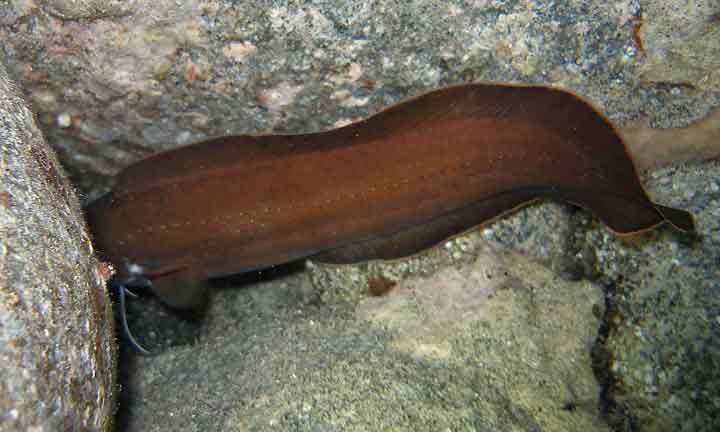
Today Bob and I finished off a student's Open Water certification class. It was a very easy day as he was very well prepared and had better buoyancy control than many of our certified divers. Bob lead the first dive at "Golden Arches", a fish filled area south of the Kona airport in the "Pine trees" area which features two sizeable underwater archways off shore. We did our second dive at "Turtle Pinnacle", a turtle cleaning station I've mentioned in earlier posts. We only had one turtle, but saw lots of cool stuff, including a horned helmet snail, a flame angel, a divided flatworm, coral banded shrimp, several eel species and other goodies. It's always fun introducing a new diver to the underwater world. Whooohoo!

Since I had a student today, I didn't have the camera with me. Here's a picture I took on yesterday's fun dive of a couple of yellow tangs. I mentioned in an earlier post that tangs are also known as surgeon fish, and have a scalpel they use for defense. The scalpel on yellow tangs is retracted except when in use, it's the white spot near the tail.

later,

Steve

Friday, June 23, 2006

Went scuba diving for fun today.


I went down to the Place of Refuge to play with the camera a bit. It does great for true macro, and is a bit off for lighting when the fish are just out of range.

I popped down deep initially to see what was out in the sand. When you go out in sand patches in Kona, you'll generally find rocks, coral heads, or garbage like tires or cement blocks which become a little oasis of life.

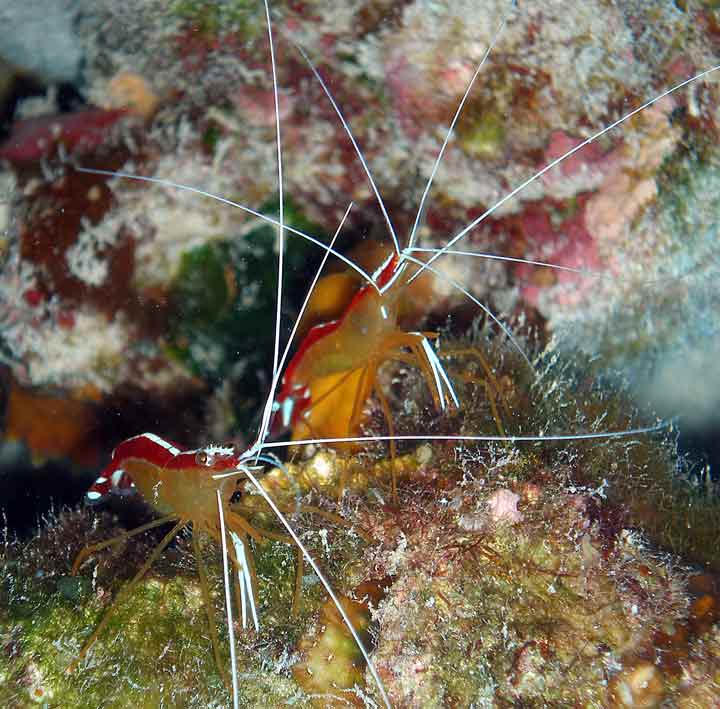
The shrimp above are cleaner shrimp, often called scarlet lady cleaner shrimp locally. In the tropical fish days I knew them as eel cleaner shrimp, as they are often associated with eels. These guys did have an eel waiting for them under the other side of the rock.

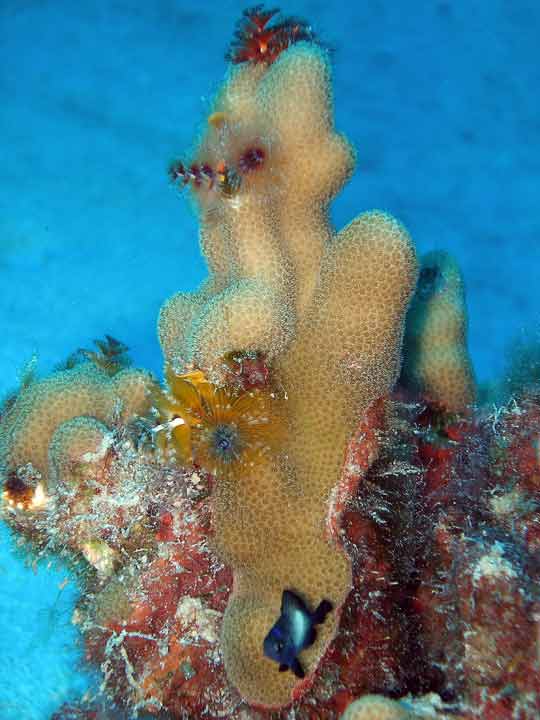
Here's a picture of a little coral growth that is loaded with christmas tree worms. Lots of corals will have critters growing in, on and around them, so it's fun to take a close look every now and then.

Water temp was 79 today. We still have a pretty big south swell, but the bay at the park was still quite protected.

Aloha,

Steve

No mantas on the manta ray night dive tonight.


Bummer. The last few nights have been off an on for the manta rays apparently. Tonight was an off night. We had plenty of plankton, but no mantas to be seen. We usually set up for the mantas and if there are none in roughly 15 minutes we'll turn it into a regular night dive and check back every so often to see if any mantas have come in.

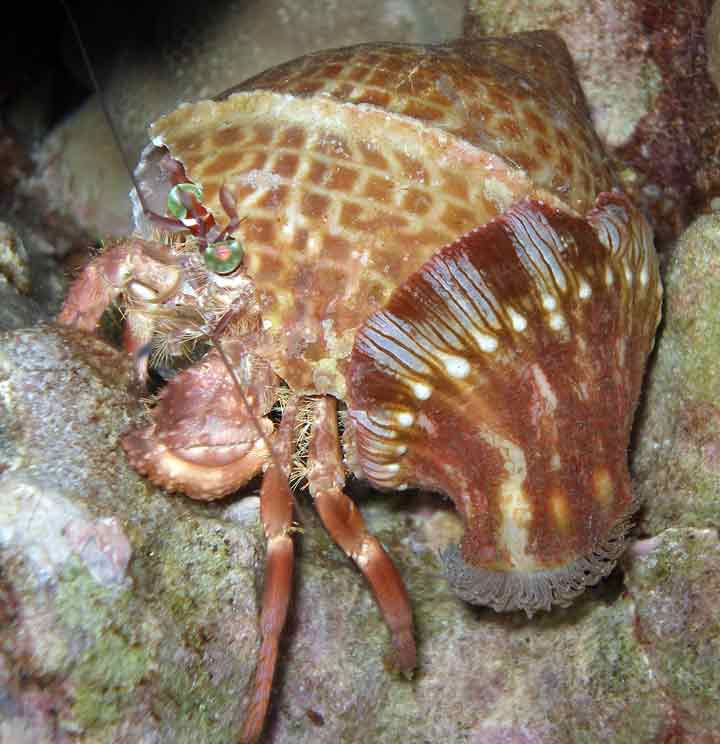
Tonight's night dive was very nice though. We saw two good sized spiny lobsters, a regal slipper lobster, several common slipper lobsters, two Hawaiian red lobsters, a large anemone hermit crab, a smaller anemone hermit crab, tons of shrimp, loads of eels out hunting and other good stuff. We had two experienced divers tonight so I took the camera down. Right now it's not really set up for night shots, I probably won't take it down on night dives 'til I figure a few things out. I'm posting a couple pics that turned out.


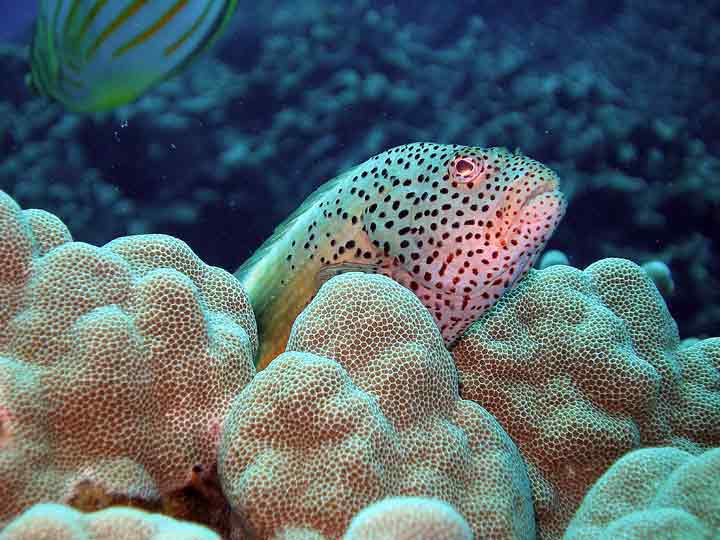
The fish at the top is a Stocky Hawkfish (Cirrhitus pinnulatus). We see these fish often at night and they have a neat color pattern. The second picture is of the smaller anemone hermit crab we saw. The third picture is of most, but not all, of a Bearded Cusk Eel (Brotula multibarbata). They look like a cross between a catfish and an eel and are not commonly seen. I posted this only because I saw one, I might not be able to get a good photo of one just because they are quite skittish and usually end up under a rock quite quickly when found.


The water temperature is still running 79 degrees according to my computer. Water conditions underwater are pretty good, but we've been having a big south swell and unseasonally odd winds the last few days which have made for choppy surface conditions. Hopefully that'll settle down soon enough.

later,

Steve